Thoughts on Using AI for Creative Stuff
Reflections on where AI fits into creative work — and where it doesn't.
After releasing the MCP Server for the Circuit Tracks and posting about it on Reddit, I started getting some feedback from multiple users, trolls or not.
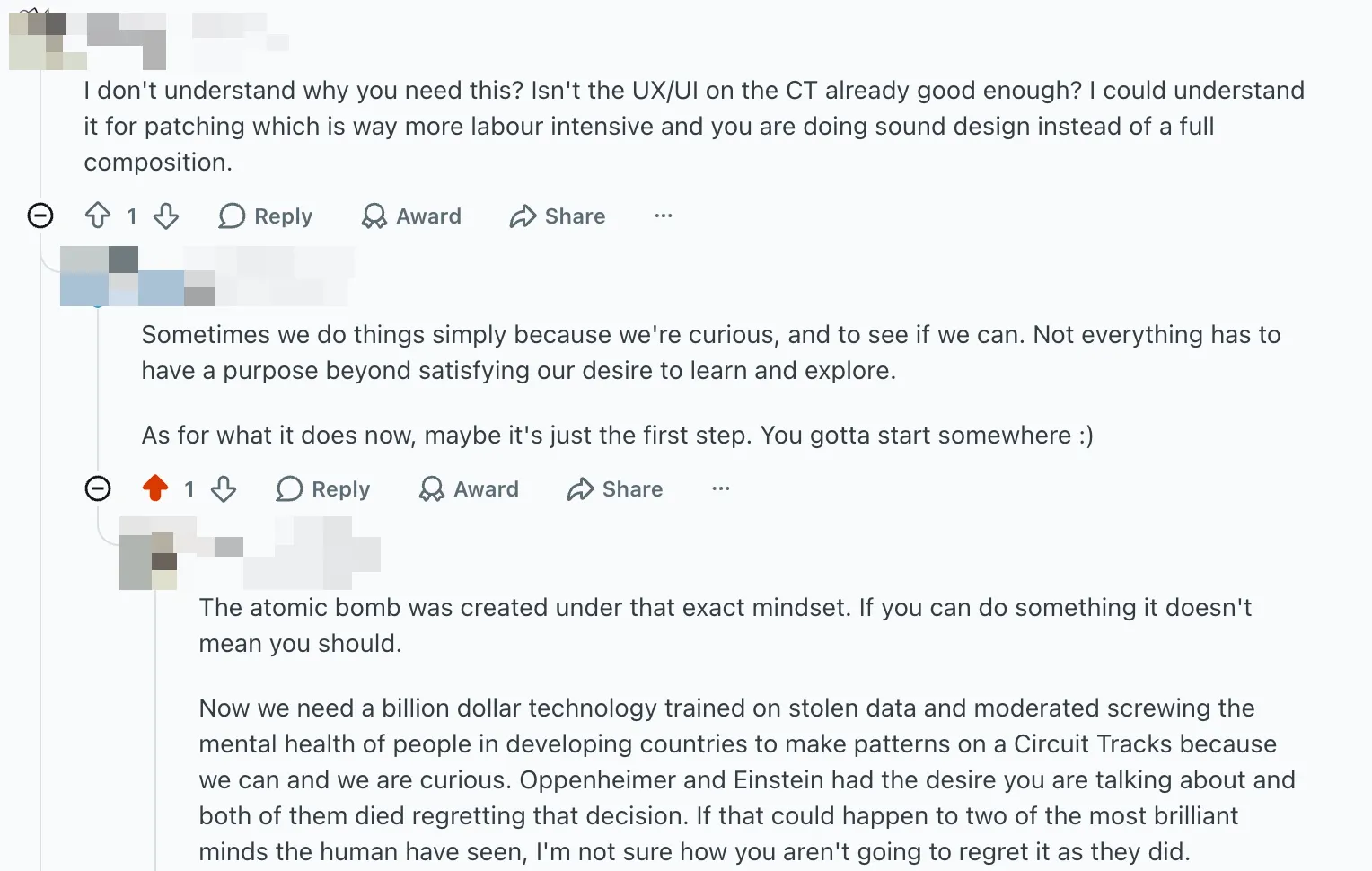
I tried to post it in another big music sub but it got rejected and I even got told by one of the maintainers that their community was really anti-AI, to the point of even disliking it for making documentation easier to access.
The general feedback could be summarized to:
- ❤️ The reverse engineering part looks cool and is interesting. ❤️
- 😡 AI for music-making or arts in general is disliked. 😡
I was really surprised about this: I expected a community that uses technology to make music to be more welcoming to such projects.
Debating with some people about this made me realize that, in general, the music-making community is really anti-AI. Their main arguments are that using AI to create music is not art, removes the happy accident and that it is a waste of resources. I can understand these thoughts and I might even share some of them to some extent, but I think we tend to see only the evil of AI.
What if we try to see the good parts? What if something like this could actually be good for the community?
AI for Accessibility
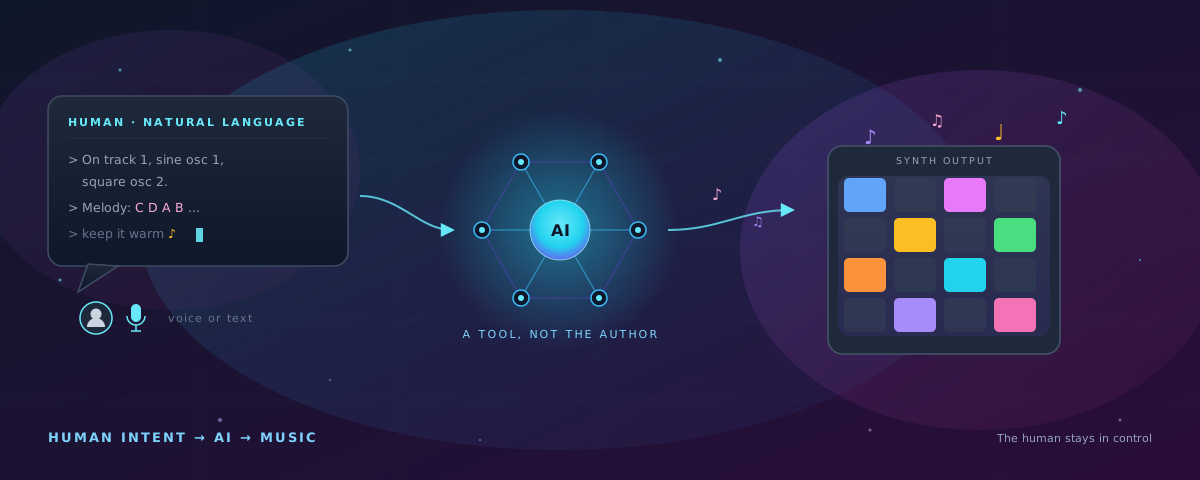
My first thought goes to accessibility: using a Circuit Tracks or other similar gear is fun, but it requires having hands to interact with the equipment. This literally excludes lots of people from using this gear even if they would know perfectly how to use it or which features it provides. A Natural Language Interface could enable musicians to use the gear autonomously through voice. An experienced musician could describe exactly what they want, e.g:
"On track 1, build a patch using a sine wave for osc 1 and a square for osc 2.
I want the following melody: C, D (6 steps), A, B....".You get the idea: the prompt is not just “Build a random song”, but rather detailed instructions. There might still be some happy accidents happening due to the non-deterministic nature of LLMs, which could push creativity.
But the human stays under control.
Potential developments could introduce voice-to-notes translation: the user would sing the melody instead of describing it. Other ideas would be to embed this in the gear directly. I assume in the future we should be able to run a capable enough LLM (or Small Language Models) directly on the gear.
I feel this usage of AI is not evil and shows how this technology can be used for public interest.
AI as Augmentation
Beyond accessibility, AI can do what every good tool has always done: extend what a human is capable of.
In the past, there were no synthesizers. If a human needed to produce a certain sound, they needed to find something in nature that sounded like this. Or if a composer had the idea to make a strings composition, they needed to actually find some good players.
Synthesizers and technology in general augmented our abilities, enabling people to do something that would have been otherwise impossible. Something beautiful, if you ask me.
I like to think about AI similarly. A composer with a vision could be able to make it happen because now it’s possible for them. A creative person without musical training could be able to make the music in their thoughts a reality.
This empowers people.
Conclusion
I believe the usage of AI in music-making and in general in art creation is still in its infancy. AI might need its Switched-on Bach moment in order to be accepted by musicians. Read this nice post and you’ll see we’ve been here before.
What are your thoughts, do you see any other beneficial uses of AI in music-making or in arts in general? Or do you think we are all doomed?
Responses
Loading...